

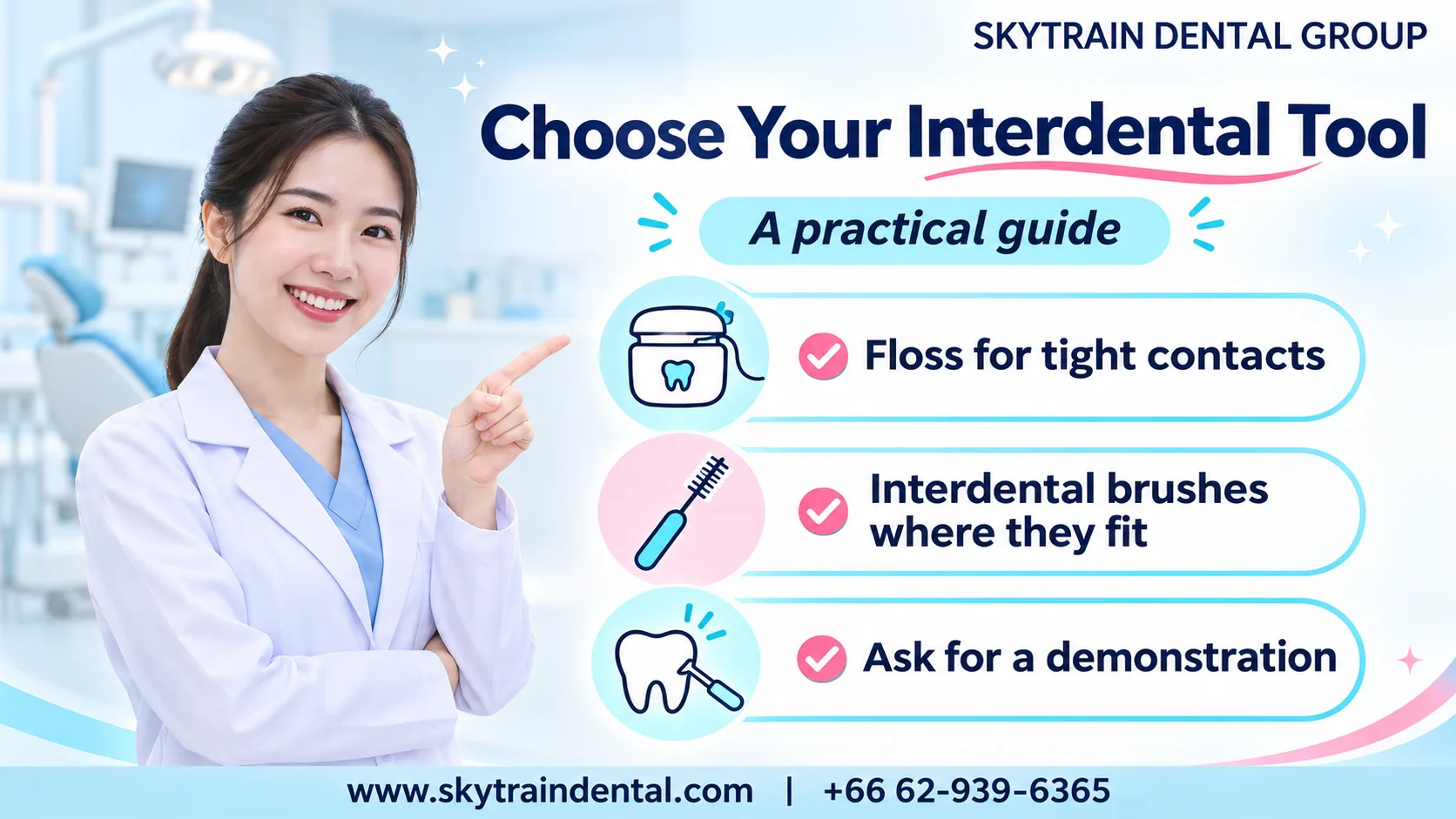
Cleaning between teeth reaches surfaces a toothbrush may miss. Floss is useful for tight contacts; interdental brushes can suit spaces where they fit. The best daily method is one that cleans your particular spaces safely and that you can use consistently.
Why brushing alone leaves gaps
Toothbrush bristles cannot reliably reach every surface between neighbouring teeth. Interdental cleaning helps remove plaque and trapped food. Evidence supports improvements in plaque or gum inflammation with some aids, but no product can guarantee that you will never develop decay or gum disease.
Choose a tool for the space
Floss or dental tape can pass through tight contacts. An interdental brush should fit comfortably through an open space without forcing the wire against teeth or gums. You may need more than one size. A water flosser or adapted handle can help with access or dexterity. Ask the dental team to match the tool to your mouth.
Use floss gently
Guide floss through the contact without snapping it. Curve it around one tooth and clean that side, then the neighbouring tooth. Use a fresh section as needed. Cleaning only the food out of the middle misses the aim of removing plaque from tooth surfaces. Do not saw aggressively into the gums.
Adapt for dental work and sore gums
Braces, fixed retainers and bridges can require threading under a wire or replacement tooth. Ask for a demonstration. Mild bleeding can accompany inflamed gums, but persistent or heavy bleeding, pain or a single repeatedly troublesome site should be checked. Daily cleaning is useful; forceful cleaning is not.
Frequently asked questions
Is floss always better than an interdental brush?
No. The right tool depends on the size and shape of the space and your gum health.
Should I floss before or after brushing?
A consistent effective routine matters most. Cleaning between teeth first can be a convenient sequence.
Can mouthwash replace interdental cleaning?
No. It does not provide the same physical cleaning of these surfaces.
Does no bleeding mean every space is clean?
Not necessarily. Ask the dentist or hygienist to check your technique and gum condition.
Speak with Skytrain Dental
For an assessment or advice about your treatment, contact Skytrain Dental Group on +66 62-939-6365 or LINE @skytraindental. Follow the instructions given by your treating clinician.
Sources and related reading
References checked 6 November 2026.
Related reading